Inspirational, Aspirational & Practical Guidelines for Yoga Teachers
The guidelines I share here are based on my experience as a student and a teacher. They are practical, aspirational and I hope inspirational. Some come easily and many I continue to work toward. In our upcoming Yoga Teacher Training, I will share my experiences and skills with our new group of teacher trainees so that they can experience and share the full, healing, challenging and empowering life that is Yoga. I’m sure these will evolve over time, as I continue to practice and learn, but here they are, in today’s form.

Me on the beach in her brace a week after fracturing my knee. This began a long cycle of Chair Yoga (an advanced practice!)
A Skillful and Compassionate Yoga Teacher:
Welcomes every body.
Helps us connect with our body, breath and heartbeat.
Invites us to follow our breath as our teacher.
Helps us to, as Shiva Rea teaches, “synch with the pulse of life.”
Teaches how to listen to our body and breath (not our thinking mind, habitual body, or external expectations) so that we can embody the practice that is most beneficial for us, on this day, in this moment.
Nurtures embodied awareness, sovereignty and growth.
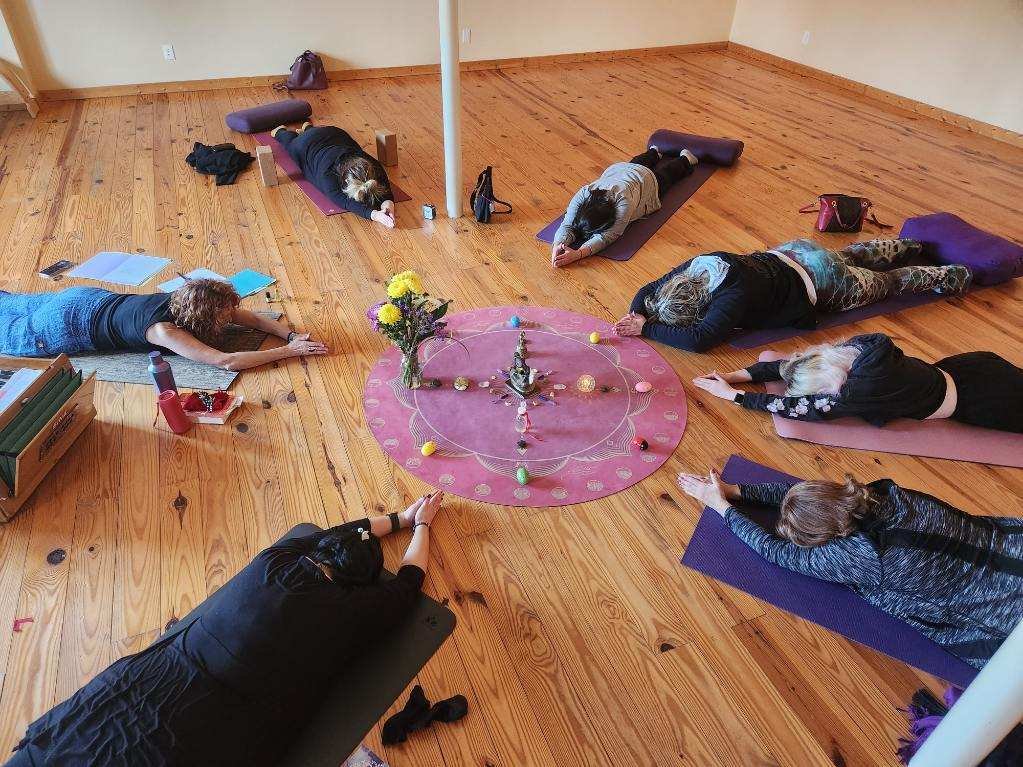
Prana Flow Ritual Pranams
Invites us to continually expand our comfort zone.
Encourages us to explore our edge: we are stronger than we think!
Reminds us that there is no physical pain in yoga: challenge is ok, pain is not.
Keeps us safe with trauma-informed language and clear instructions that don’t require an anatomy degree.
Provides options for every body (including chairs, the wall and other props), that allow us to experience the practice most fully in a way that is appropriate for us in this moment.
Empowers us to adjust the practice as we need, without fear of over-adjusting or over-correction.
Offers hands-on assists - when we are open to them - to help us embody the practice in the most beneficial way - and never in a rebuking tone.
Understands the importance of softness and rest and the power of Shavasana for integration.
Honors the fullness of Yoga.

Sunrise in Kerala, India
Throughout the practice, offers seeds of Yoga teachings that go beyond the physical, nurturing curiosity and inviting us to go deeper, to enjoy movement as meditation.
Honors the roots of Yoga, using Sanskrit to expand awareness and respect, but never to exclude or confuse.
Honors their teachers and lineages.
Is a lifelong student, studying with teachers who are also lifelong students.
Seeks to live a Yogic life.
Shares their authentic self.

Me on the beach, my happy place
Weaves the threads of their own passions and practices into their offerings.
Shares practices that support the community.
Doesn’t take themselves too seriously or place themselves above us, the students.
Has clear boundaries.
Is a warm-hearted friend on the path.
And inspires us to grow.

Sunrise over The Great Marsh, Indiana Dunes National Park
About These Guidelines
As I’ve been preparing for the upcoming Prana Vinyasa Embodying the Flow Yoga Teacher Training and Immersion, I’ve spent quite a bit of time reflecting on what makes a “good” Yoga teacher and I share my thoughts here. These are based on what I experience so much with my primary teacher and inspiration, Shiva Rea; my Sanskrit teacher Dr Rama Shankar; and many other teachers along the way. It also takes into account the negative experiences I’ve had and want to avoid.

Me with my primary teacher, Shiva Rea, in Delphi, Greece
As I reconsidered the title, I realized I didn’t want to imply the dualism of Good vs Bad, so I searched for a better word than “Good.” I first considered “Skilled.” But I wanted to convey that my idea of “A Good Yoga Teacher” did not just encompass technique or skill. It’s also about our Heart Spirit. The title transformed from “A Good Yoga Teacher” to “A Skillful and Compassionate Teacher.”
I also chose the term Teacher rather than Instructor. In my mind, an instructor provides information to help us acquire a defined set of knowledge or skills (like a driving instructor). I see a teacher’s role as broader and deeper than an instructor’s: not only helping us acquire a skill, but also providing mentorship and - most importantly - encouraging a lifelong love of learning. A teacher helps widen our perspective, helps us see connections between disparate pieces of information and inspires us to grow.